Start with what the villa is for
The right villa for a family moving to Phuket is different from the right villa for six weeks a year and rental income. Decide this first, because it drives every later choice.
| Main use | What matters most | Areas buyers often consider |
|---|---|---|
| Living with children | Schools, hospital, shops, quiet road | Bang Tao/Cherng Talay, Kathu, Rawai/Nai Harn |
| Holiday home | Easy airport access, low maintenance, security | Bang Tao, Layan, Kamala |
| Rental income | Legal rental route, location guests want, operator | Bang Tao, Kamala, managed estates |
| Retirement | Flat access, healthcare, community | Rawai, Nai Harn, Chalong |
Then be honest about how often you will be there. A villa empty for ten months a year needs a caretaker or a rental plan; see our property management guide. If you are unsure between a villa and a condo, our condo vs villa guide compares them side by side.
Set an all-in budget
Example only: a completed villa at 25 m THB (≈ USD 746,000) bought on a registered lease, where the lease is valued at 18 m THB and the house at 7 m THB.
| Item | Estimate |
|---|---|
| Price | 25,000,000 THB |
| Lease registration and stamp duty (1.1% of 18 m) | 198,000 THB |
| Transfer fee on the house (2% of 7 m appraised, buyer's half) | 70,000 THB |
| Independent lawyer and due diligence | 80,000–150,000 THB |
| Furniture top-up, set-up | depends on condition |
| First year running costs and reserve | ask for last year's bills |
Land Office fees are calculated on appraised values, which are often below the contract price, so treat these as upper bounds. Seller-side taxes (specific business tax or stamp duty and withholding tax) are normally paid by the seller; make sure the contract says so. Full detail in our taxes and fees guide.
If you will pay from abroad, plan the money route now: our money transfer guide explains why it matters even for a leasehold villa.
Shortlist and view: in person, by drone and in 3D
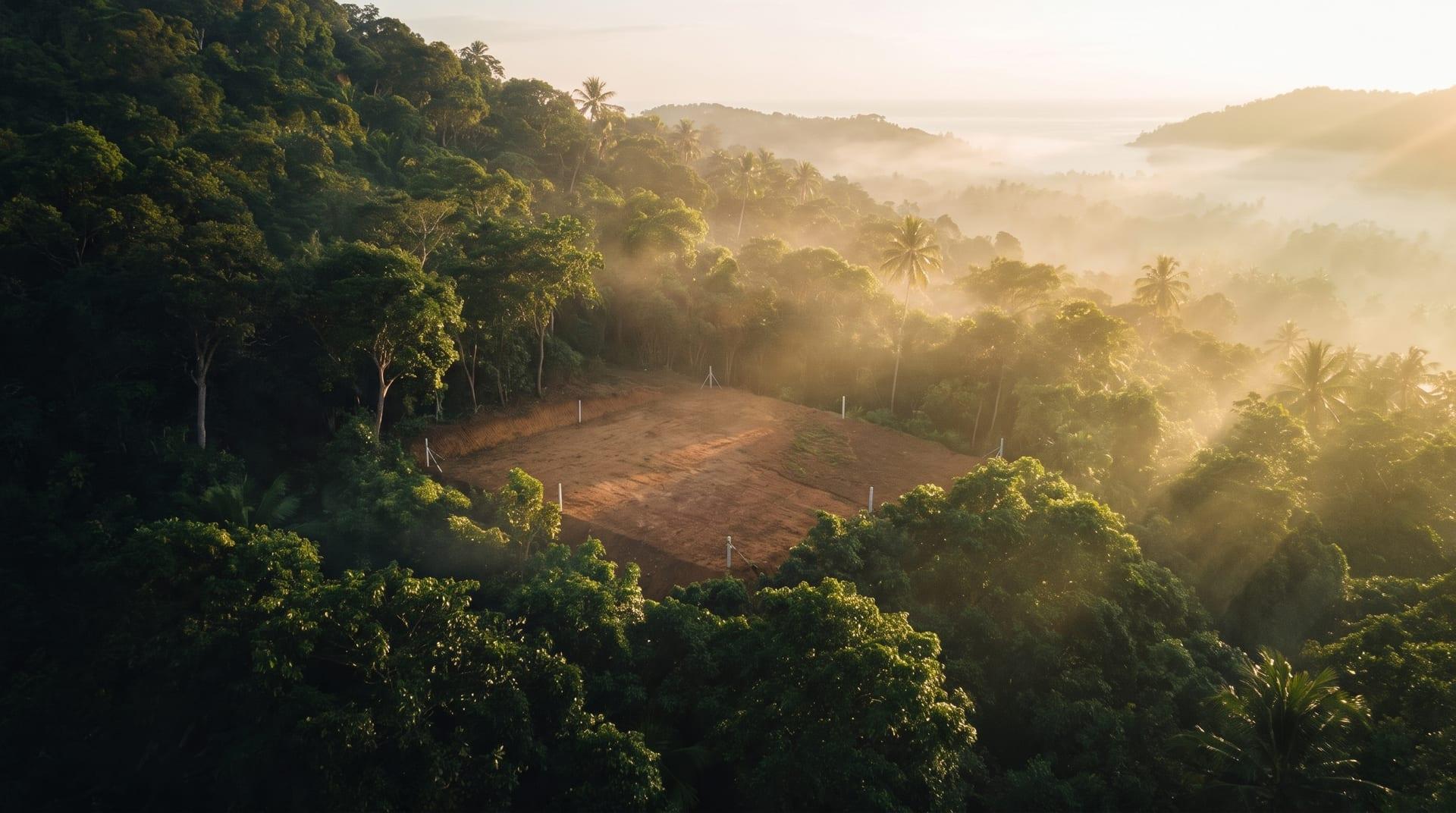
Most buyers now shortlist from abroad. A drone flyover shows what photos hide: the neighbours, the road, the slope, the distance to the sea and any construction next door. A 360° room tour shows layout and finish quality. Use them to cut a long list to three or four villas, then see those in person if you can.
What to check on a viewing
- Access: the road surface, the gradient, and whether it is a public road or a private track.
- Water: drainage around the house, signs of damp or mould, the condition of the pool equipment.
- Build quality: roof and terraces, window frames, timber, electrical board, air conditioning age.
- Noise and light: main roads, bars, construction, the sun on the pool through the day.
- The neighbourhood at night and on a weekday morning: traffic toward schools and town.
Our listings include drone footage and a 3D tour so you can do the first two rounds from home: browse the catalogue.
Reserve, check, sign, register
- Reservation: a short agreement and a deposit, typically a small percentage of the price or a fixed sum. Make it refundable if due diligence fails, and take the villa off the market.
- Due diligence by your independent lawyer: title and encumbrances at the Land Office, access, permits, the seller, and the lease and house documents. Our due diligence guide lists the checks.
- Sale and lease contracts: price, what is included, payment schedule, who pays which fee, lease term, registration, succession to heirs, assignment and renewal wording.
- Payments: by traceable bank transfer; keep every document.
- Land Office: the lease (and superficies or house transfer) is registered and fees are paid. Same day, by appointment.
- Handover: keys, inventory, utility accounts moved to your name, manuals and warranties, and the estate or caretaker contacts.
For a completed villa with clean paperwork this usually takes four to ten weeks. Off-plan villas follow a different rhythm; see our off-plan guide.
Buying remotely
You do not have to be in Phuket for every step. Many buyers view by video and 3D tour, visit once to see the final choice, and complete through their lawyer.
- Power of attorney: signed in front of a notary at home and legalised (apostille or consular legalisation), with a Thai translation. The Land Office has its own form; your lawyer will send it.
- Video call viewings of the actual villa, walking the boundaries and the access road live.
- Independent inspection: a building inspector can report on structure, damp, electrics and pool equipment with photos.
- Payments from your own account abroad, with documents kept for each transfer.
For buyers from Russia and the CIS, plan two to four weeks for the power of attorney with apostille and translation, and confirm in advance which bank route will work for your payments.
When you are ready to start, tell us what you are looking for. We shortlist, film what you need to see, and introduce an independent lawyer for the checks.
How to buy a villa in Phuket as a foreigner
- Step 1
Define use and budget
Decide how you will use the villa and set an all-in budget including fees, lawyer, furniture and a year of running costs.
- Step 2
Shortlist by area and footage
Narrow down areas, then use drone flyovers and 3D tours to cut the list to three or four villas.
- Step 3
View and inspect
Visit or video-call the finalists; check access, drainage, build quality and noise; consider an independent inspection.
- Step 4
Reserve with a refundable deposit
Sign a short reservation that refunds the deposit if due diligence fails and takes the villa off the market.
- Step 5
Due diligence by your lawyer
An independent lawyer checks title, encumbrances, access, permits, the seller and the lease terms, and reports in writing.
- Step 6
Sign contracts and pay
Sign bilingual sale and lease contracts, then pay by traceable bank transfer and keep every document.
- Step 7
Register at the Land Office
Register the lease and the house right, pay the fees, and collect the registered documents.
- Step 8
Take over and make a Thai will
Move utilities into your name, set up maintenance, and sign a Thai will covering the villa.
Questions buyers ask
How long does it take to buy a villa in Phuket?
For a completed villa with clean paperwork, usually four to ten weeks from reservation to registration: two to four weeks of due diligence, time to agree contracts and transfer funds, and one Land Office appointment. Off-plan villas follow the construction schedule.
Can I buy a villa in Phuket without visiting?
Yes. Buyers commonly shortlist by drone footage and 3D tours, view the final choice by live video, commission an independent inspection, and complete through a lawyer holding a legalised power of attorney. We still recommend seeing the villa once if you can.
What deposit is normal to reserve a villa?
Commonly a small percentage of the price or a fixed sum agreed with the seller. What matters more than the amount is the condition: the deposit should be refundable if your lawyer's checks find problems, and the reservation should take the villa off the market.
Do I need a Thai bank account to buy a villa?
It is not strictly required for a leasehold villa, but it helps: it makes payments traceable, simplifies paying bills afterwards, and lets you hold documents for each transfer. For a freehold condo, a Thai account receiving your foreign transfer is the usual way to get an FET.
Sources
Editorial guidance, not legal or tax advice. Thai rules change; confirm your case with an independent Thai lawyer before paying a deposit.